Warby Parker Direct to Consumer Business Model Disrupting Traditional Eyewear Industry
A pair of prescription glasses used to feel like a small tax on seeing the world clearly. The eyewear industry gave shoppers polished retail counters, designer logos, confusing lens add-ons, and a bill that often felt bigger than the frame in their hands. Warby Parker walked into that frustration with a cleaner bargain: better-looking glasses, direct pricing, and fewer reasons to feel trapped. Its official filings describe the company as a pioneer of direct selling, with in-house design in New York and prescription glasses starting at $95, while its newer footprint now includes hundreds of stores and vision-care services.
That mix matters. Warby Parker was never only an online glasses retailer. It was a brand that made the old buying process look tired. If you study growth stories through a site like business model breakdowns for modern brands, the lesson is clear: the company did not replace stores with websites. It replaced customer confusion with control. Then it used stores when stores made control stronger.
Why the Direct Channel Was a Price Story Before It Was a Tech Story
Warby Parker’s early power came from a plain consumer feeling: “Why does this cost so much?” The brand turned that question into a shopping path that felt calmer. It designed frames, sold them under its own name, and spoke in prices people could understand. That was the first wedge. Tech helped, but the emotional move was price relief. For a U.S. shopper paying rent, student loans, child-care bills, or a high deductible, a predictable starting price was not a cute feature. It was permission to shop without bracing for the cashier.
Direct-to-consumer eyewear made the middle feel optional
The old glasses trip often had too many hands in the sale. You got an exam in one place, looked at frames in another corner, picked lenses through a menu, and left wondering which part created the final bill. Warby Parker’s direct-to-consumer eyewear pitch cut through that fog. The frame, lens, brand, and service sat under one roof.
That does not mean every shopper saved money in every case. Insurance, lens type, prescription needs, and store promotions can change the math. The deeper shift was mental. A fixed starting price made the buying process feel less like a negotiation and more like a choice.
Here is the non-obvious part: the company’s advantage was not only lower price. It was lower anxiety. Many Americans will pay more when they understand why. They resist when the checkout line feels like a trap. Warby Parker made the price feel named before the shopper got emotionally attached to a frame.
A good example is the first-time adult buyer who has aged out of a parent’s plan. That person does not want an education in lens economics while standing under bright retail lights. They want to know whether they can get a pair that looks adult, works for a laptop-heavy job, and does not wreck the month’s budget. Warby Parker answered that mood better than many legacy sellers.
Brand trust came from reducing small frictions
The company’s old Home Try-On program became one of its best-known moves because it moved the fitting room into the home. That specific program has ended, but Warby Parker still points shoppers toward Virtual Try-On, its Advisor tool, a style quiz, and in-store visits as ways to test frames before buying.
That change says something useful about modern retail. The famous tactic can fade, while the habit it created stays alive. Customers learned that buying glasses could start on a couch, continue on a phone, and end in a store without feeling broken.
For small brands, this is the part worth copying before the software. Remove the little doubts. Will it fit? Can I return it? What happens if I need help? What will lenses cost? A clean answer to those questions can do more than a flashy ad. A DTC eyewear brand earns trust by making the shopper feel ahead of the process, not behind it.
There is also a quiet social layer. Glasses are not hidden under a jacket or tucked inside a bag. They announce taste every time you speak to a coworker, meet a client, or walk into a date. Warby Parker made that taste decision feel less risky by giving people more ways to preview themselves before paying.
How Warby Parker Changed the Eyewear Industry Without Staying Online
The surprising thing about Warby Parker is that its digital story became stronger after it embraced physical retail. Many brands treat stores as a retreat from online growth. Warby Parker treated them as proof that the customer journey was never one channel. In a category tied to fit, face shape, prescription accuracy, and medical service, the store became a tool, not a surrender. That is where the disruption matured: it stopped acting like an e-commerce trick and started looking like a new operating system for optical shopping.
Stores solved what screens could not solve
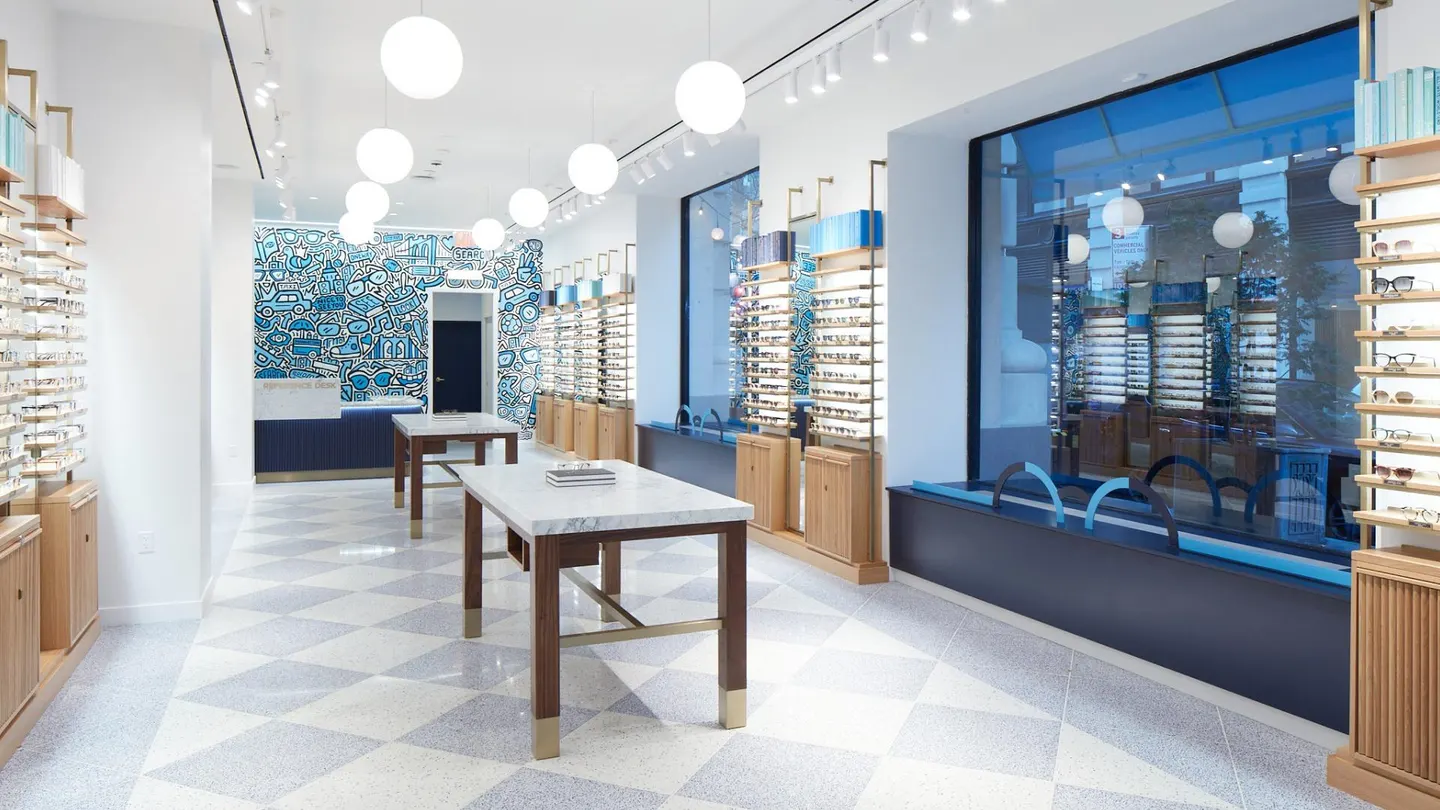
Glasses sit on your face. That sounds obvious, but it changes the whole model. A shirt can be a little loose and still work. A frame that slides down your nose all day becomes a regret. This is why the company’s store rollout matters. Its 2025 filing says it ended the year with 323 retail stores, and 285 of them offered in-person eye exams.
That store count does not make Warby Parker a traditional chain in spirit. The stores act like showrooms, service hubs, exam centers, pickup points, and local billboards. A person might discover the brand on Instagram, book an exam near a Target, try five frames after work, then reorder contacts online months later.
The counterintuitive lesson is sharp: a direct brand can grow more direct by opening stores. The point is not to avoid rent at all costs. The point is to own the customer relationship. When the store gives the brand richer service, better fit confidence, and more local visibility, it can protect the direct relationship instead of weakening it.
This matters in suburbs as much as big cities. A shopper in Dallas, Phoenix, Tampa, or Columbus may like online browsing but still want one human check before buying progressives. That person is not rejecting digital retail. They are asking the brand to meet the risk level of the purchase.
Online glasses retailer is now too small a label
Calling Warby Parker an online glasses retailer misses where the business has moved. The company now sells frames, lenses, contacts, eye exams, lens enhancements, and vision tests across connected channels. Its filing frames the goal as a convenient one-stop shop for eye care, not a single product website.
That shift matters for revenue quality. A college student might enter through a $95 pair. Years later, that same customer may need progressives, prescription sunglasses, contacts, or an exam. Warby Parker is trying to stay present through those life stages without handing the customer back to the old optical counter.
There is a risk here too. More services mean more operations. Eye exams require trained professionals. Contacts carry thinner margins. Stores need leases, staff, and local demand. The lesson for founders is not “add more products.” It is “add the next service only when it deepens the reason customers return.”
The traditional market still has giants with deep assets. Reuters noted in 2025 that EssilorLuxottica owns major outlets such as LensCrafters, Sunglass Hut, and For Eyes, along with well-known brands and licenses. A U.S. judge dismissed consumer antitrust lawsuits against the company, but the case still shows how much attention the structure of the optical market receives. Warby Parker’s answer was not to out-muscle that system. It made a parallel path.
The Store Network Turned DTC Into a Healthcare Funnel
The next stage of Warby Parker’s model is less about selling cute frames and more about owning the eye-care visit. That move is harder than selling online, but it also gives the company a larger role in the customer’s year. You may buy frames every couple of years. You may need an exam, contact refill, lens update, repair, or new prescription sooner than that. This is where the model becomes stickier. Not louder. Stickier.
Optical retail strategy now depends on exams
Warby Parker’s filings show why exams matter. The company reported that in 2025, net revenue rose to $871.9 million, up 13.0% from 2024. It pointed to 47 new stores, active-customer growth, and higher average revenue per customer as drivers, with contacts and eye exams often bought alongside glasses.
That is the model becoming denser. A store with exams is not only a place to browse frames. It can begin the purchase. It can capture the prescription moment. It can also make the brand feel more serious, especially for older shoppers and families who want human help before they spend.
The quiet insight is that healthcare credibility can make a fashion brand feel safer. Warby Parker built style into the front door, but eye care gives the business a second door. For a shopper with a strong prescription or a first pair of progressives, that second door can matter more than the frame wall.
Think about a parent bringing in a teenager for a first real pair. The parent may care about price. The teen may care about style. Both care about whether the prescription is right. A brand that can handle the exam, fit, lens choice, and replacement path has more chances to earn the family’s next purchase.
The market still favors human help
The U.S. optical market is huge, but it is not acting like pure e-commerce. The Vision Council estimated the U.S. optical market at $69.5 billion in 2025 and reported that more than 80% of frames and lenses were bought in physical locations. That is not a small footnote. It explains why a digital-only story would have hit a ceiling.
This also explains why the FTC’s prescription-release rule matters. The FTC Eyeglass Rule requires eye doctors to give patients a copy of their prescription after a refractive exam and before offering to sell glasses, which supports consumer choice and comparison shopping.
Warby Parker benefits from that consumer-choice environment, but it also has to win after the prescription is free to travel. That is the hard part. The brand cannot rely only on access. It has to make the next step feel better than the alternatives. That is where fit tools, service, pricing, store design, and follow-up all carry weight.
The hidden tension is that freedom creates pressure. If a customer can take a prescription anywhere, the store that performed the exam has to earn the frame sale on merit. Warby Parker’s model works best when the customer thinks, “I could shop around, but I do not need to.” That feeling is more valuable than a captive sale.
What Other Brands Should Copy, and What They Should Leave Alone
Warby Parker is a tempting case study because the surface looks simple: sell direct, charge less, look stylish, grow fast. That reading is too thin. The stronger lesson is that the company attacked a broken buying ritual. It found confusion, embarrassment, sticker shock, and inconvenience. Then it built each channel around removing one of those pains. The model is not a magic template. It is a method for finding friction and turning it into brand trust.
Copy the customer control, not the category playbook
A furniture startup, a skincare line, or a local service brand should not copy Warby Parker frame by frame. The useful move is to map where customers feel trapped. In glasses, the trap was price opacity and limited choice. In furniture, it may be delivery windows. In skincare, it may be ingredient doubt. In home services, it may be surprise fees.
That is why customer retention strategies for service brands and pricing strategy for small businesses fit the same discussion. The best channel strategy begins with the customer’s bad moment. Warby Parker’s optical retail strategy worked because each channel answered a clear worry.
The non-obvious lesson is that lower price alone is weak. A cheaper brand can still feel risky. Warby Parker paired price with taste, social proof, free trial behavior, and later local care. That mix made the deal feel safe. Safety sells when the product sits on your face.
For a small U.S. business, the practical exercise is simple. Write down the moment when the customer hesitates. Then write the answer the customer wishes the market already gave them. The channel comes after that. Website, store, text message, appointment, sample kit, or phone call should serve the answer, not the founder’s favorite growth theory.
Leave room for the model to change
Warby Parker’s current model does not look like its launch model. That is a sign of discipline, not failure. The old story was online disruption. The newer story is connected care. In 2025, the company also disclosed opportunities in contacts, eye exams, vision insurance, and premium lenses, while noting that contacts made up only 11.1% of its net revenue and exams and vision care only 6.4%.
The company is also moving into a wider future for glasses. Reuters reported that Warby Parker and Google plan to launch lightweight AI-powered glasses in 2026, using Google’s Android XR platform and Gemini AI model, though pricing and distribution details were not provided at the time.
That future should be read with care. Smart glasses may create new demand, but they may also bring privacy worries, higher prices, and support burdens. The stronger business lesson is not that every brand needs AI. It is that a brand with trust, stores, customer data, and face-worn product knowledge may have a better shot at testing new behavior than a pure tech firm with no daily retail relationship.
A brand becomes fragile when it falls in love with its launch story. Warby Parker’s better habit has been letting the promise stay steady while the format changes. Clearer pricing, better control, less buying stress. Those ideas can survive a website, a store, an exam room, or a smart-glasses trial.
Conclusion
Warby Parker’s rise is often told as a clean internet story, but the better lesson is messier and more useful. The brand won early because it made buying glasses feel fairer. Then it kept adapting because glasses are personal, medical, visual, and emotional at once. A website could start that relationship, but it could not answer every need.
The next test will be harder than the first. The eyewear industry is moving through higher consumer spending, store-heavy buying habits, insurance complexity, premium lenses, contact refills, and smart-glasses experiments. Warby Parker has to protect its original promise while running a larger, more service-heavy company.
For business owners, the takeaway is direct: disruption is not a channel. It is a better answer to a customer’s worst moment. Find that moment, remove the fear around it, and build only the channels that make the answer stronger.
Frequently Asked Questions
How does Warby Parker make money from its direct model?
Warby Parker earns revenue by selling prescription glasses, sunglasses, contacts, lens upgrades, eye exams, and related vision services. Its direct model helps it control design, pricing, brand experience, and customer data while stores add exams, fittings, and local awareness.
Is Warby Parker still mainly an online glasses retailer?
No. Online remains part of the buying path, but the company now runs a large store network and offers in-person exams in many locations. The better label is an omnichannel vision-care brand with digital tools, stores, and service-based revenue.
Why did Warby Parker open stores if it started online?
Stores solve problems that screens cannot fully handle, such as frame fit, face shape, prescription support, progressives, repairs, and eye exams. In this category, physical locations can raise confidence and bring shoppers back more often.
What made Warby Parker different from traditional optical stores?
It made pricing easier to understand, designed frames under its own brand, sold direct to customers, and used digital tools to reduce friction. Traditional stores often relied on layered pricing, third-party brands, and a more confusing lens-selection process.
Are Warby Parker glasses always cheaper than other options?
Not always. Final cost depends on prescription, lenses, insurance, upgrades, and promotions elsewhere. The brand’s advantage is clearer entry pricing and a calmer buying process, which can feel better than chasing discounts across several providers.
What can small businesses learn from Warby Parker?
Start with the customer’s most annoying buying moment. Warby Parker attacked price confusion, fit anxiety, and limited choice. A small business can do the same in its own market by making costs, service steps, returns, and support easier to trust.
Does Warby Parker’s model depend on physical stores now?
Stores play a major role, but they work with the digital channel rather than replacing it. The model depends on connection between browsing, exams, fittings, purchases, reorders, and follow-up care. Each channel has to make the next step easier.
Will smart glasses change Warby Parker’s future?
They could, but the outcome is not guaranteed. Smart glasses add technology, privacy, support, and pricing challenges. Warby Parker’s advantage is that it already understands face fit, optical retail, and customer trust, which may help if the category grows.